
Dolphin Stranding at Aultbea
British Divers Marine Life Rescue volunteers were called to help a dolphin in Loch Ewe.
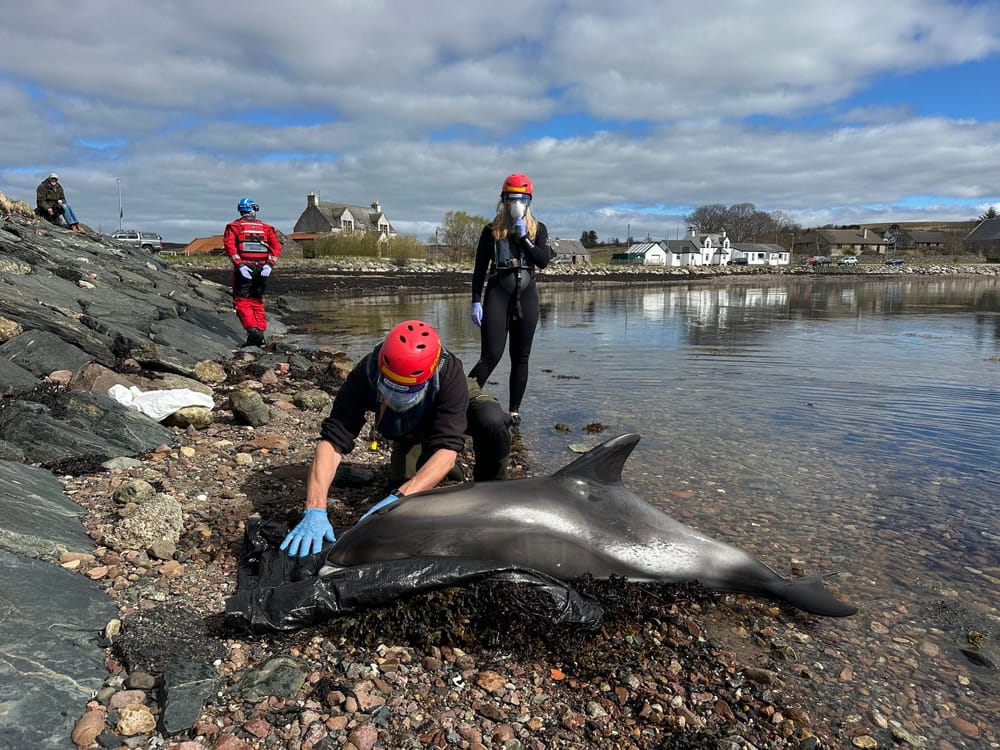
On Wednesday 22nd April 2026 concerned locals spotted what was initially thought to be a harbour porpoise floundering in the shallows in Loch Ewe, directly in front of Aultbea Village Stores. Local British Divers Marine Life Rescue (BDMLR) medic Matt Larsen-Daw was alerted and attended the scene, and found that in fact it was a rarer visitor to our coastal waters – a white-beaked dolphin. Here Matt recounts the events of the day.
White-beaked dolphins are sturdy cetaceans capable of swimming at great speeds and performing acrobatic jumps out of the water. They are only found in the temperate and subarctic waters of the North Atlantic, and unlike the more often spotted short-beaked common dolphins (confusingly sporting a longer ‘beak’ than white-beaked dolphins) are usually only seen in open waters further from the coast – especially around the outer Hebrides.
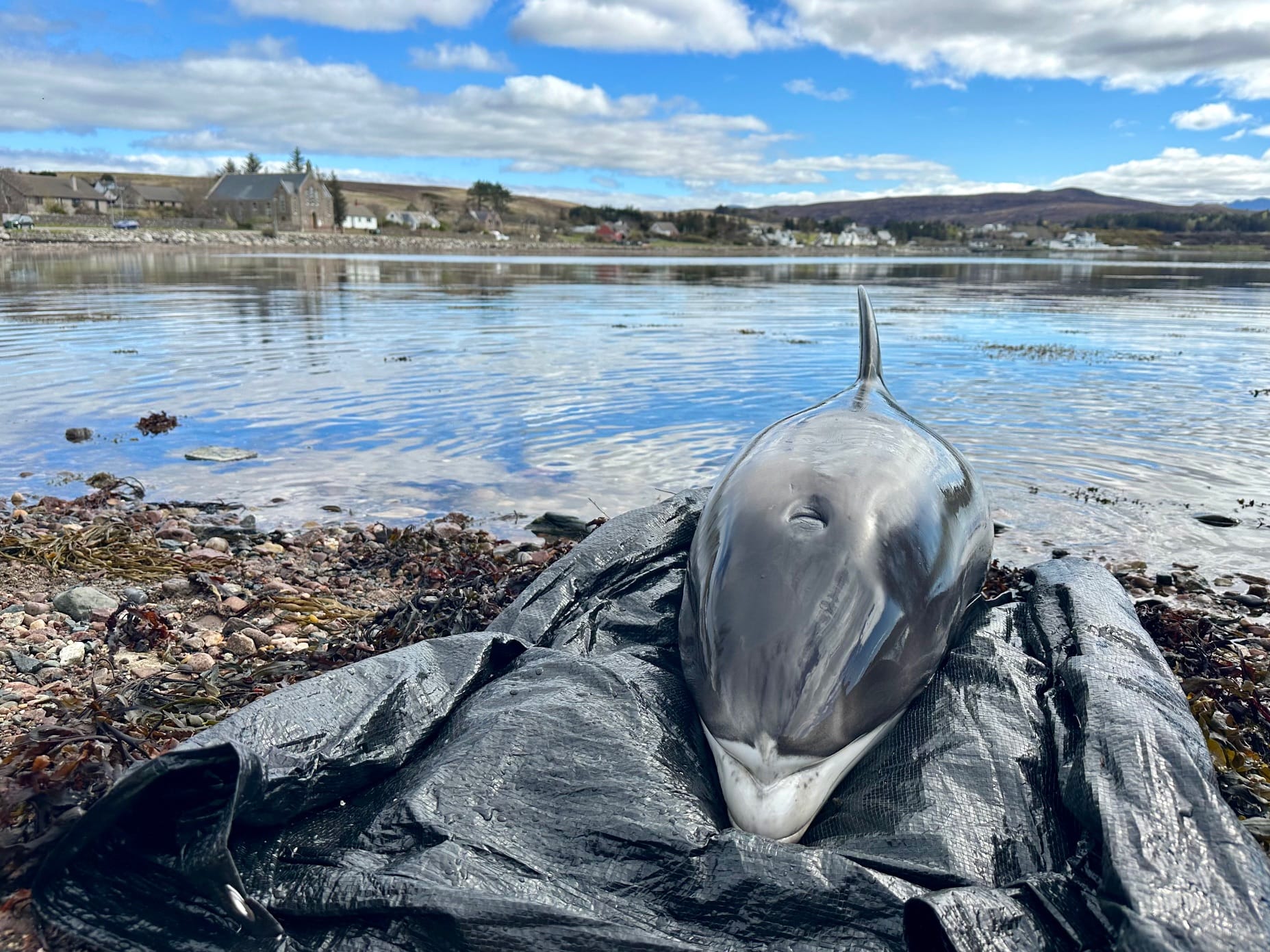
They have a dark grey back, tail and pectoral fins, and a tall, dark-grey sickle-shaped dorsal fin. Greyish-white flashes along the flanks and a pale grey patch behind the dorsal fin (known as the saddle-patch) can help distinguish them from other species, but the clearest physical characteristic is the short, white beak.
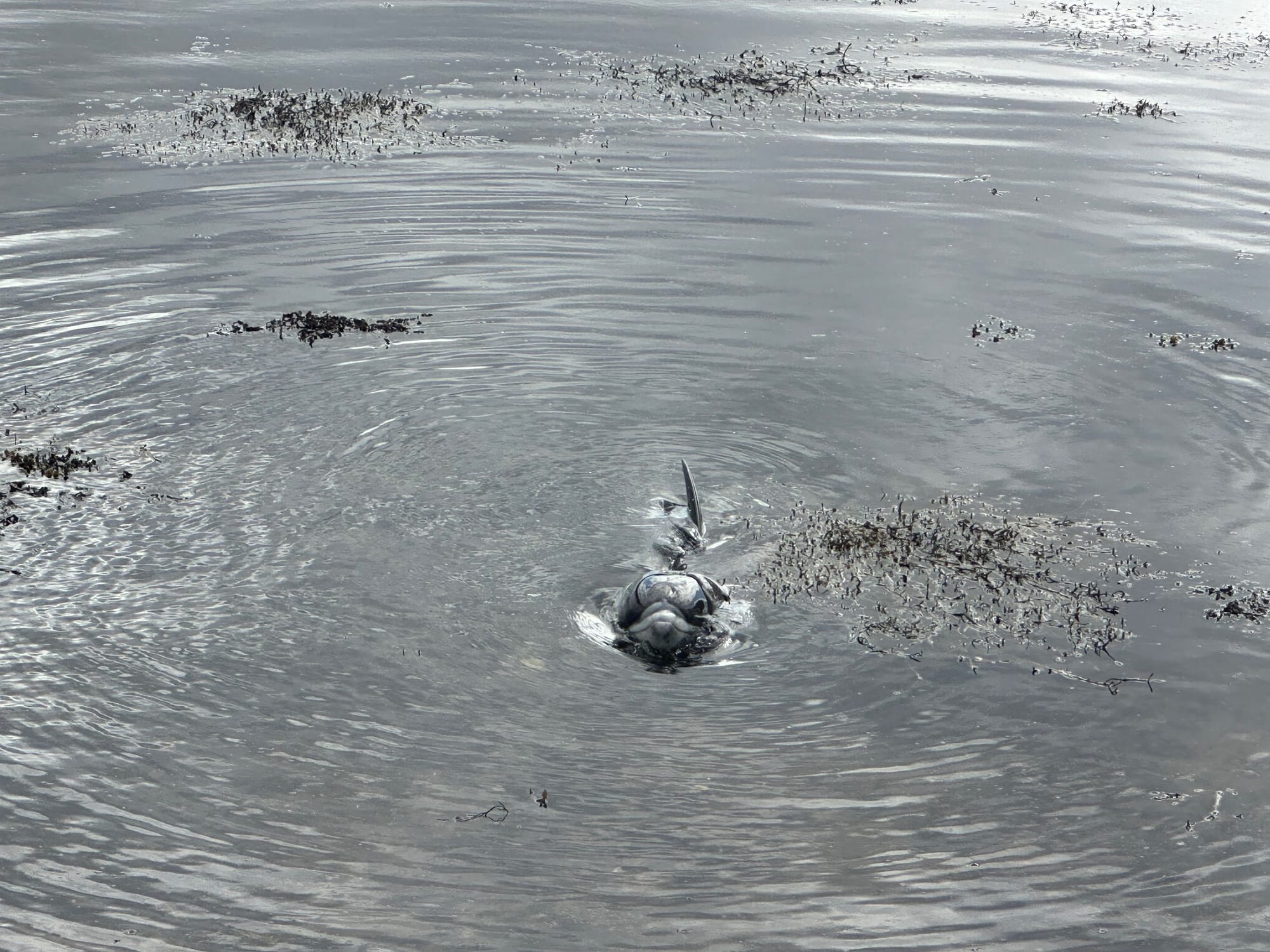
A fully grown white beaked dolphin can be as long as 3.1 metres and up to 350 kg in weight, however in this case the animal was under 2 metres, contributing to it being initially confused with the smaller harbour porpoise. Although there was no sign of entanglement or external injury, the dolphin seemed unable to stay level when swimming, and alternated between periods of frantic splashing with its tail, and listing to one side just feet from shore.
BDMLR put out the call to the local network of volunteer medics, and within an hour a team had assembled to help the dolphin and ensure the best possible outcome. Regional BDMLR coordinator Donna, and volunteer medics Nic, Kirsty and Ciará joined Matt on the shore of Loch Ewe, and were swiftly joined by three representatives from the coastguard deployed to oversee the safety of the medics when entering the water to help the animal.
A call to BDMLR allows for input from cetacean experts, including qualified vets. The size and behaviour of the animal led to concern for its wellbeing, and the decision was made that the attendant BDMLR medics should enter the water and bring the dolphin out onto shore where it could be properly assessed, and if necessary treated or moved to the other side of the pier where it would be more likely to succeed in identifying the route to open water.
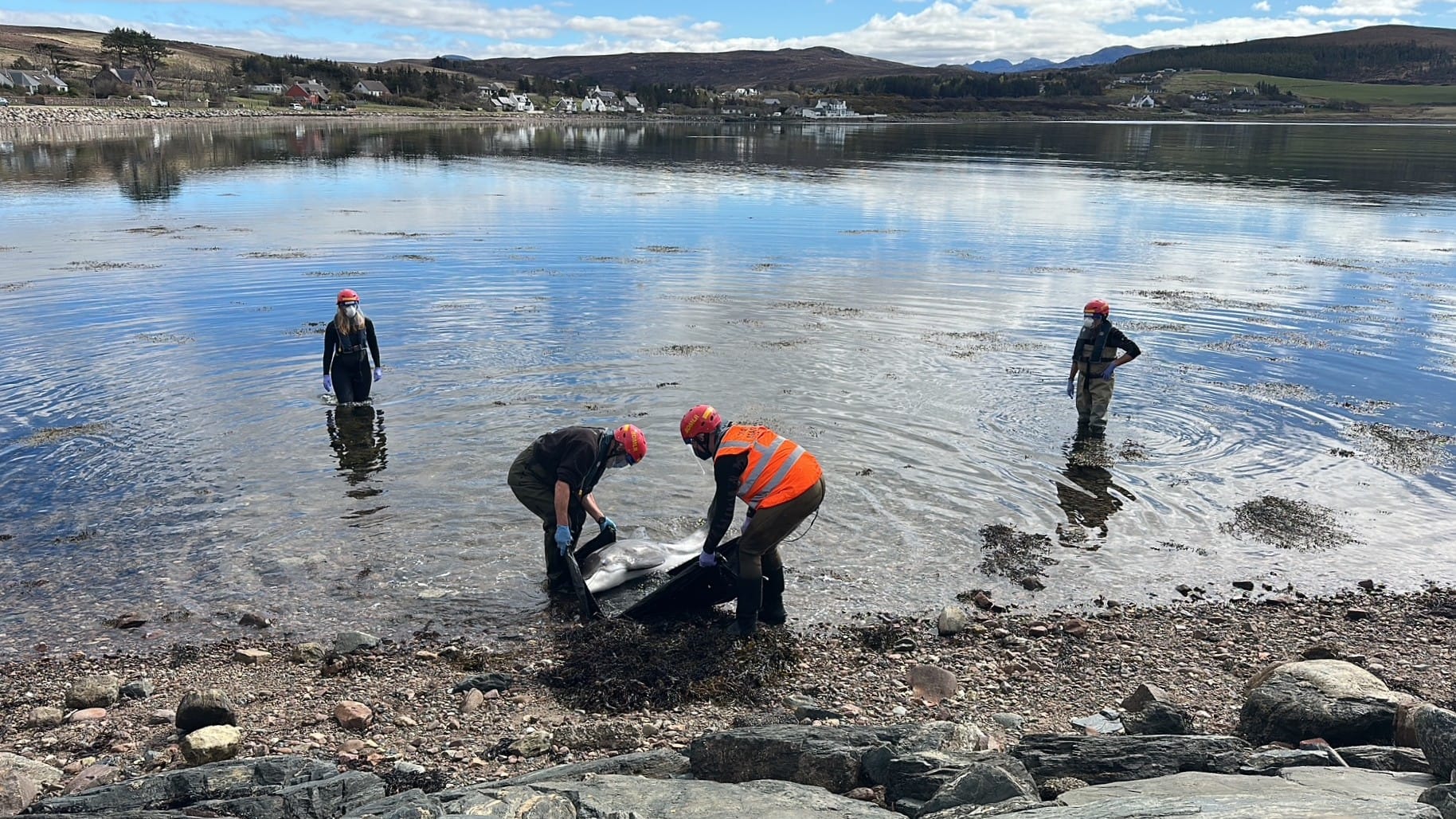
Throughout this assessment the dolphin remained as close as possible to the shoreline where volunteers stood ready to assist, and made absolutely no objection to being guided to the beach and gently laid down on a tarpaulin and some wet seaweed. It is always dangerous to anthropomorphise the behaviour of wild animals, but it did seem that it recognised that it was in need of help and that we might be able to give support.
The physical assessment concluded that it was a juvenile, and in fact may be so young as to still be maternally dependent, which drastically lowers its chances of survival when separated from its mother. The animal was also observed to be underweight and exhibiting signs of illness (possibly pneumonia), and sadly it was ultimately decided that it had no chance of survival in the water, and that euthanasia would be the most humane action to take.
Since no vet could be found that was able to travel to Aultbea and administer a lethal injection, euthanasia was carried out by gunshot. The dolphin’s body has been taken to the Scottish Marine Stranding Scheme (SMASS) so that causes of the stranding can be gleaned along with other data about the animal’s condition that will contribute to important research aimed at informing marine mammal conservation.
For BDMLR medics this is always a heart-rending outcome, but putting an animal to sleep when it has no chance of survival is a way that the suffering of a wild animal can be minimised. This intervention also contains and manages a situation that could otherwise cause risk to other wild animals or humans if a sick cetacean was left to fend for itself in the ocean with no prospects of survival, and ultimately strand elsewhere after a painful and protracted death.
Viruses that affect cetaceans can be zoonotic – meaning they can transfer to humans as well as to others of their species. BDMLR medics are trained in avoiding such risks and are equipped with PPE in the form of gloves, face masks and face screens.
This is one of several reasons why you should never intervene if you find a marine mammal stranded or in distress, even if there seems to be an obvious way to help. Well-intentioned intervention could put yourself and the animal at risk, and cause an injured or sick animal to flee, preventing informed and well-planned help that could maximise its chances. Even trained BDMLR medics feed local observations and information back to the head office and follow instructions that are guided by top cetacean experts and vets.
I’d like to extend a huge thank you to all those who gave time and energy to help resolve this incident – including thoughtful local residents who initially raised the alert, and those who offered the BDMLR team tea, freshly baked muffins, bottled water, a power bank to charge mobile phones, and even the loan of wheelie bins to shade the dolphin from the hot sun.
If you suspect a marine mammal is in distress, please call BDMLR to report it, providing as much information as possible, including a photo if you can take one without getting close, and a What 3 Words location. 01825 765546
If you find a marine mammal stranded and already deceased, do not approach it and keep dogs and other humans at a distance, then report it to SMASS. 07979 245893
To support the work of BDMLR Wester Ross, you can make a donation here: JustGiving
Comments ()